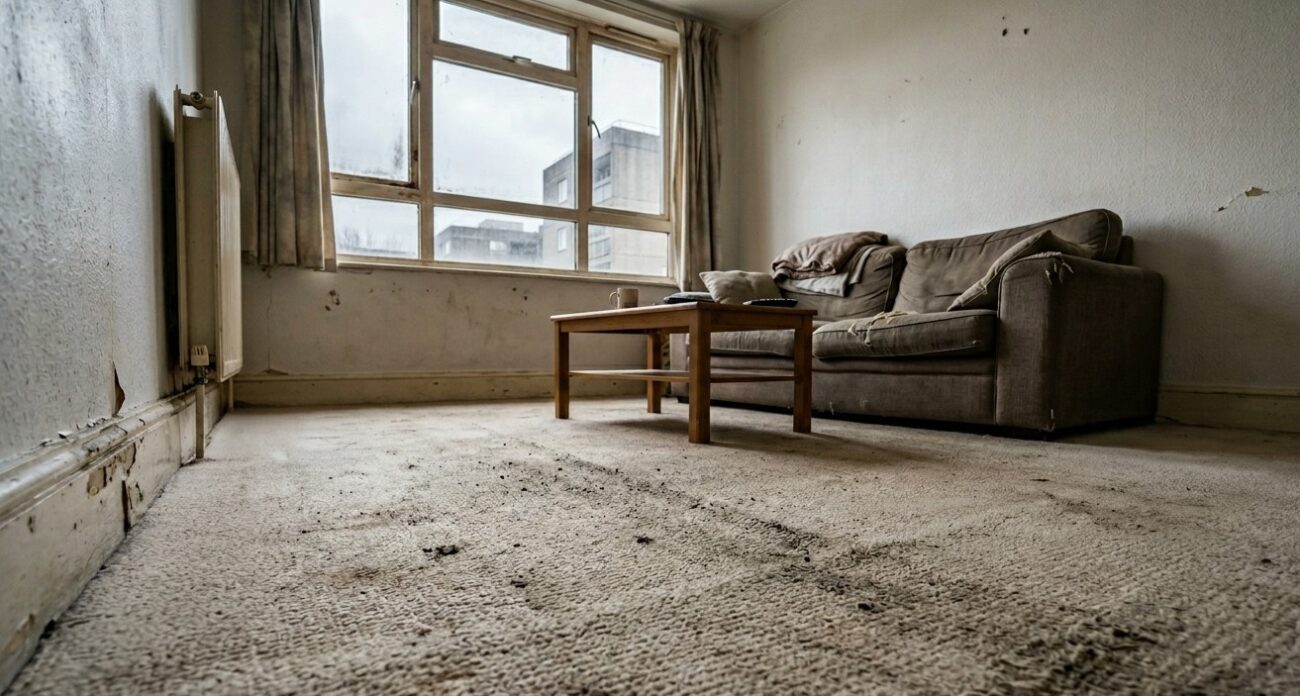
There is a specific kind of carpet that exists only in ex-council flats, and if you have ever moved into one, you will recognise it immediately. It is usually a shade that was once, in some optimistic decade past, described in a catalogue as “warm harvest” or “autumn mist” or possibly “executive beige.” It has the texture of something that has absorbed a remarkable quantity of human life and has no intention of surrendering any of it. And somewhere across its surface – near the window, in front of where the sofa clearly stood for twenty years, or in a suspiciously generous area by the radiator – there are stains. Stains of indeterminate age. Stains of indeterminate origin. Stains that have quietly persisted through multiple tenancies, at least two changes of government, and very possibly the 1990 World Cup. This is how you deal with them.
Understanding What You’re Actually Working With
Before applying a single product to an ex-council carpet, it is worth spending a few minutes properly understanding its character – because these carpets have specific properties that set them apart from anything purchased at a contemporary flooring retailer.
Council-specification carpets laid from the 1960s through to the 1990s were typically heavy-duty, commercial-grade materials selected for durability and nothing else. Many are wool-blend or heavy synthetic broadloom, laid over thick felt underlay and built to survive decades of continuous occupation with the absolute minimum of professional intervention. They are, in a specific and grudging sense, very well made. The difficulty is that “built to last through anything” and “straightforward to clean” are not the same specification, and a carpet engineered to absorb heavy daily traffic absorbs everything else with equal and indiscriminate enthusiasm.
What this means in practice is that you may be confronting multiple generations of accumulated cleaning product residue built up in the pile, staining that has penetrated through to the backing, pile so compressed in traffic areas that it may never fully recover, and the ghost of whatever the previous tenant applied in their own well-meaning attempts to address the situation. You are not simply cleaning a carpet. You are conducting an archaeological excavation with a spray bottle, and a degree of humility about the outcomes is warranted from the outset.
Assess Before You Act – The Test Patch Principle
Given the age and entirely unknown history of these carpets, testing before committing to any cleaning product is not optional caution – it is basic self-preservation.
Find a small, genuinely inconspicuous area of pile – inside a built-in wardrobe, or a corner that will be permanently hidden beneath a heavy piece of furniture – and test any product you intend to use before deploying it anywhere visible. Older carpet dyes, particularly on wool-blend materials from the 1970s and 1980s, can be considerably less colourfast than modern equivalents. A perfectly competent cleaning solution that performs without incident on a contemporary carpet can cause dye bleed on an older one, leaving you in a materially worse position than the mystery stain did. The test patch takes five minutes and can save a significant amount of anguish.
Ventilate the flat thoroughly before starting. Old carpets in properties with limited airflow can harbour mould or mildew deep in the backing that becomes more active when disturbed and dampened. Open every window available, and if the weather is cooperating, prop the front door as well. The neighbours may find this mildly puzzling. That is an entirely acceptable price.
A Brief Taxonomy of Mystery Stains
Not all old stains are equally cooperative, and identifying the general category you are dealing with – even when the specific origin is lost irretrievably to history – helps determine the most effective approach.
Old Organic Stains
These are the most common category and, relatively speaking, the most responsive to treatment. Food, drink, and biological residues that have dried and set over years respond well to enzymatic cleaners, which break down organic compounds at a molecular level rather than simply moving them sideways. An enzymatic solution applied generously, covered with cling film to slow evaporation, and left to dwell for several hours – or overnight for older, more deeply established staining – will make meaningful progress where every previous tenant’s hasty five-minute attempt failed entirely.
The operative variable with old organic stains is dwell time. A product applied and blotted after a few minutes is doing a fraction of the work it would accomplish given four to six hours of contact. Patience is, genuinely, the active ingredient.
Paint and DIY Residues
Ex-council properties have frequently been personalised by successive tenants with varying degrees of enthusiasm and technical competence, and the carpets routinely bear the evidence. Dried emulsion paint is water-based and, if it has not fully cured into the fibre, can be softened with warm water and worked free with a stiff brush. Oil-based paint, gloss, and varnish are considerably more involved, requiring a solvent-based treatment applied carefully to a cloth rather than directly onto the carpet, and blotted patiently rather than rubbed at.
The honest reality about paint residue that has been walked flat over many years is that removal is likely to be partial rather than complete. A paint splash that has been ground into the pile by a decade of foot traffic has effectively become part of the carpet’s texture. Improvement is achievable; complete invisibility, in most cases, is not.
The Truly Unidentifiable
Every ex-council carpet contains at least one stain that resists all classification. It is a particular colour that does not correspond to anything obvious. It has an unusual shape. It may have a faint associated texture that raises more questions than it answers. It offers absolutely no clues as to its origins, and extended scrutiny only deepens the mystery.
For these, the most rational approach is sequential treatment – working through the likely categories methodically and assessing progress after each stage. Enzymatic cleaner first, addressing the possibility of organic origin. A dry-cleaning solvent applied sparingly if that produces limited results, addressing an oily or chemical source. A mild detergent solution as a final stage. This process-of-elimination approach resolves the majority of unidentifiable stains simply by covering the probable categories in order, without requiring a definitive answer to the question of what actually caused them.
The Deep Cleaning Method
Stage 1 – Thorough Dry Treatment First
Begin with a deliberate, unhurried vacuum – considerably more methodical than a standard clean. Use slow overlapping passes, work against the pile direction as well as with it, and give specific attention to the room perimeter where decades of particulate matter will have accumulated in the filtration soiling patterns that old properties accumulate faithfully. An ex-council carpet treated to a proper vacuum will release a quantity of material that may genuinely surprise you. This is entirely the point.
Once vacuumed, apply bicarbonate of soda generously across the full carpet surface, work it gently into the pile, and leave it for a minimum of four hours – overnight if circumstances allow. This deodorises, absorbs residual moisture within the pile, and neutralises some of the acidic and alkaline compounds contributing to that particular background odour common to long-occupied properties. Vacuum it away completely and thoroughly before any wet treatment begins.
Stage 2 – Stain Pre-Treatment
Working through the stain categories identified during your initial assessment, pre-treat each problem area with the relevant product before any general wet cleaning takes place. Allow each treatment its full recommended dwell time before blotting. Address stains individually rather than applying multiple products simultaneously – doing so makes it impossible to assess what is working, and can produce unpredictable interactions between chemicals. Move to a clean section of white cloth with each blotting press, always working from the outer edge of the stain inward.
Stage 3 – General Wet Cleaning
For a full flat’s worth of old, heavy carpet, a hired carpet cleaning machine is the domestic equivalent of professional hot water extraction, and it is considerably more effective than hand-cleaning alone for this scale of job. These machines are widely available from hire shops and some larger supermarkets, and for an ex-council flat they are worth every penny of the hire cost.
Follow the dilution instructions carefully – the instinct to use more cleaning solution than recommended, in the belief that more product equals more clean, is counterproductive. Excess detergent left in the pile attracts fresh dirt rapidly, frequently undoing the work within weeks. Work from the furthest corner toward the door, overlapping each pass slightly, and make a final pass with clean water only to rinse residual detergent from the fibres.
Stage 4 – Drying Properly
An old, dense carpet over heavy underlay retains moisture for considerably longer than a modern domestic equivalent, and the consequences of insufficient drying are worse in a property that may already have some relevant history. Keep windows open, maximise airflow through the flat, and resist the temptation to replace furniture or allow foot traffic until the carpet is dry all the way through – not merely dry at the surface. Press your palm firmly into the pile at the deepest, most sheltered areas of each room to check. Surface dryness at the pile tips does not indicate a dry backing, and the backing is where the problems develop.
Honest Expectations – What Deep Cleaning Can and Cannot Achieve
Approached properly, deep cleaning an ex-council carpet can produce results that are genuinely surprising – far better than its pre-treatment appearance would suggest possible. These are robust materials and they respond well to proper attention, sometimes revealing a colour and resilience that has been buried under decades of accumulated grime.
What the process cannot do is reverse the physical compression of pile that has been walked flat for thirty-odd years, restore colour lost to significant fading, or eliminate staining that has fully bonded with the carpet backing. The carpet after treatment will be markedly cleaner, fresher, and considerably more presentable – but not restored to anything approximating its original state. Managing that expectation honestly before you begin saves considerable disappointment at the end.
When the Carpet Has Simply Lived Its Life
There comes a point with some ex-council carpets where deep cleaning is an act of stubborn optimism rather than practical judgement. If the pile has worn flat across significant areas, if multiple large stains have resisted pre-treatment, if the backing shows signs of deterioration or the carpet has developed permanent rippling that no amount of cleaning will address – the evidence is pointing in one direction.
A carpet that has served its purpose faithfully across four or five decades and several households has, by any reasonable measure, done its job. The appropriate response is not another round of cleaning products. It is acknowledgement, a degree of respect for the sheer durability of the thing, and a trip to a flooring supplier.
Word count: approx. 1,603 words
