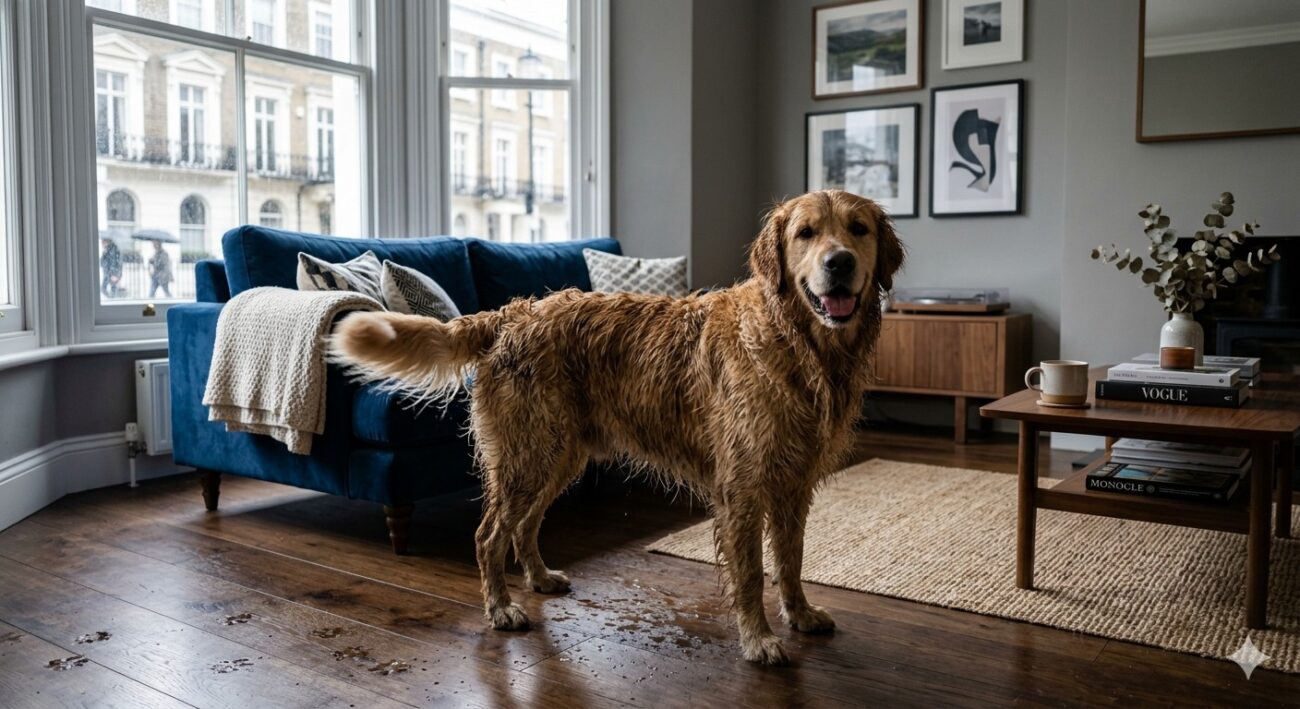
There is a particular sensory experience that every dog owner in Britain knows with uncomfortable intimacy, and it arrives without warning. One moment you have a perfectly pleasant living room. The next, your beloved Labrador has come bounding in from the garden after an enthusiastic encounter with a puddle – or, if you live near one of London’s parks, an encounter with something considerably worse – and your carpet has become ground zero for one of nature’s most stubbornly unpleasant aromas. Wet dog smell is, in a word, tenacious. It clings to carpet fibres with a commitment that is almost admirable. It survives open windows, scented candles, and the kind of aggressive air freshener deployment that ought to come with a warning label. But it is not, mercifully, permanent – provided you know what you are actually dealing with and how to address it properly. Which is precisely what this article is here to explain.
Why A Wet Dog Smells So Much Worse Than a Dry One
You might reasonably wonder why your dog smells perfectly acceptable when dry but becomes an olfactory menace the moment he gets wet. The answer lies in microbiology, which sounds alarming but is actually quite straightforward.
Dog fur naturally hosts colonies of bacteria and yeast – this is entirely normal and not a reflection of poor hygiene on your dog’s part (he is, in all likelihood, extremely pleased with himself regardless). When the fur is dry, these microorganisms produce only a modest amount of volatile organic compounds, which are the chemicals responsible for odour. When water is introduced, however, those compounds are mobilised and released into the air at a considerably faster rate. The wet fur essentially becomes a diffuser, and your carpet – absorbent, fibrous, and conveniently close to the ground where a shaking dog can cause maximum disruption – becomes the primary recipient.
This is also why the smell often intensifies as the carpet dries out: the evaporation process actively drives those volatile compounds upward and outward into the room. You clean up the visible evidence, settle back onto the sofa, and find that twenty minutes later the room smells considerably worse than it did immediately after the incident. This is not your imagination. It is chemistry, and it is deeply unfair.
Don’t Wait – Why the First Hour Matters
The temptation, after a wet dog has done his worst and retreated to his bed wearing an expression of complete innocence, is to light a candle, make a cup of tea, and deal with it later. This is entirely understandable. It is also a mistake.
Odour compounds from wet dog begin bonding with carpet fibres very quickly, and the longer they are left undisturbed, the more thoroughly they embed. What can be addressed relatively straightforwardly in the first hour becomes noticeably more stubborn after several hours, and genuinely resistant once the carpet has dried with the odour fully set into the pile.
The other pressing concern is moisture itself. A damp carpet left too long – particularly in a room with limited airflow, which covers a significant proportion of London living rooms in winter – creates the ideal conditions for mould and mildew, which will add their own considerable and rather different contribution to the overall atmosphere. Act promptly, and the job remains manageable.
What You’ll Need
Good news: the toolkit for this particular job is almost entirely composed of things you already have somewhere in the kitchen. Here is what to gather before you begin:
- Clean, dry white towels or thick white kitchen roll
- Bicarbonate of soda – a large box, and do not be stingy about it
- White wine vinegar
- Cold water
- A clean spray bottle
- A small amount of washing-up liquid
- An enzymatic pet odour neutraliser – optional, but genuinely worth having for households with repeat offenders
A brief note on what not to reach for: bleach is an absolute non-starter on carpet fibres of any kind. Strongly perfumed sprays and commercial air fresheners are equally beside the point – they do not neutralise odour compounds, they simply overlay them temporarily, and the effect lasts approximately as long as your optimism did. The objective here is to treat the cause, not perform cosmetic work on the symptom.
The Step-by-Step Method
Step 1 – Remove Excess Moisture First
Before anything else, your priority is extracting as much moisture from the carpet as quickly as possible. Lay dry white towels over the affected area and press down firmly – stand on them if necessary, it genuinely helps. The goal is to transfer moisture from the carpet into the towel rather than simply pushing it sideways.
Replace the towels as they become saturated and continue until they come away relatively dry. If the dog responsible is of the larger, more enthusiastically aquatic variety – your golden retrievers, your spaniels, your suspiciously self-satisfied Weimaraners – this stage may take rather longer than you expect. Be thorough about it. The drier you can get the carpet at this early stage, the less work everything that follows has to do, and the less likely you are to end up with a secondary mildew problem layered on top of the original one.
Step 2 – Bicarbonate of Soda (The Overnight Treatment)
Bicarbonate of soda is, without exaggeration, one of the hardest-working substances in a domestic cleaner’s toolkit. It does not simply mask odours – it actively absorbs and neutralises them by interacting chemically with the acidic and alkaline compounds responsible for the smell. For wet dog odour embedded in carpet pile, it is the natural and very effective first resort.
Once the carpet is as dry as towels can get it, apply a generous, even layer of bicarbonate of soda across the entire affected area. Do not be timid – you want clearly visible, even coverage across the pile, not a delicate dusting. Work it very gently into the surface fibres with your fingertips or a soft brush, then leave it completely undisturbed.
Overnight is the ideal contact time. A minimum of four to five hours will produce results, but leaving it overnight is meaningfully better – the longer the bicarbonate of soda sits in contact with the pile, the more thoroughly it can do its work. In the morning, vacuum it up completely using slow, deliberate, overlapping passes. Rushing the vacuuming and leaving bicarbonate of soda residue in the pile is a very common error, and one worth avoiding.
Step 3 – The Vinegar and Water Solution
White wine vinegar has something of a reputation problem owing to its own rather assertive smell, which is admittedly not subtle. But here is the important thing: it dissipates almost completely as it dries, and it takes the odour compounds it has neutralised along with it. It is also mildly acidic, which makes it highly effective against the alkaline bacterial compounds that give wet dog its distinctive character. It earns its place here.
Mix equal parts white wine vinegar and cold water in your spray bottle, then add a small squeeze of washing-up liquid. Shake gently. Spray the solution lightly and evenly over the treated area – and the emphasis there is genuinely on lightly. You want the surface of the carpet damp, not wet. This is not the moment to recreate the moisture problem you just spent twenty minutes solving.
Leave it to work for ten to fifteen minutes, then blot firmly with clean white cloths using the pressing motion you are now well acquainted with. Never rub. Repeat the blotting with plain cold water to rinse, then blot dry once more with fresh towels.
Step 4 – Drying Thoroughly and Ventilating the Room
With the treatment complete, your focus shifts entirely to drying the carpet as fully as possible, without resorting to direct heat on the fibres.
Open windows to create airflow through the room wherever the weather permits. If the sky is doing something characteristically British and unhelpful, a fan positioned at a reasonable distance to circulate air across the carpet surface is perfectly sensible – a hairdryer aimed directly at the pile, or a portable heater pushed close to the carpet, is not. Apply dry towels with firm pressure once more to lift remaining surface moisture, then allow the carpet to air dry completely and naturally.
Once fully dry, a second light application of bicarbonate of soda left for a couple of hours and then vacuumed away carefully will catch any residual odour the first round may have missed. Consider it a finishing pass rather than starting the process over again.
Long-Term Prevention – Because This Will Almost Certainly Happen Again
If you share your home with a dog who has any relationship at all with the outdoors – and in London that typically means parks, common land, and a great many puddles of ambiguous origin – this is not a one-time problem. It is a lifestyle. Planning accordingly makes the whole thing considerably less fraught.
A dedicated dog towel kept near the front or back door and deployed immediately upon re-entry after wet weather is the single most effective preventative measure available. It sounds obvious precisely because it is, and yet it transforms the situation entirely. Drying your dog before he has the opportunity to deposit half a puddle onto your carpet eliminates the problem at source rather than managing the consequences afterwards.
For households with particularly large or particularly enthusiastic dogs, an enzymatic pet odour neutraliser applied to high-traffic carpet areas once a month works by breaking down organic compounds that accumulate gradually in the pile, rather than masking them with fragrance. Used consistently, it keeps background odour levels genuinely low rather than merely bearable. A thick, brush-pile doormat at every entry point also makes a meaningful difference to how much moisture reaches the carpet in the first place – far more than the decorative flat ones that do essentially nothing except look vaguely welcoming.
When Home Treatment Isn’t Quite Enough
For most wet dog incidents, the steps above will leave your carpet smelling neutral and your household equilibrium fully restored. There are situations, however, where the problem runs deeper than a single afternoon’s treatment can address.
A carpet subjected to repeated wet dog incidents over months or years – particularly without prompt treatment each time – can develop odour that has penetrated through the pile and into the carpet backing and the underlay beneath. Surface treatment, however conscientious, addresses only a fraction of the actual problem in that scenario. The smell will return, because its source is no longer in the fibres you are cleaning.
Any situation that involves mildew given time to establish itself properly – identifiable by a musty, earthy note sitting underneath the wet dog smell rather than replacing it – also represents a more involved challenge. The mildew requires treatment in its own right, not simply deodorising over, and addressing it at the depth where it actually lives generally requires professional equipment and methods that go well beyond what is achievable with towels and bicarbonate of soda.
