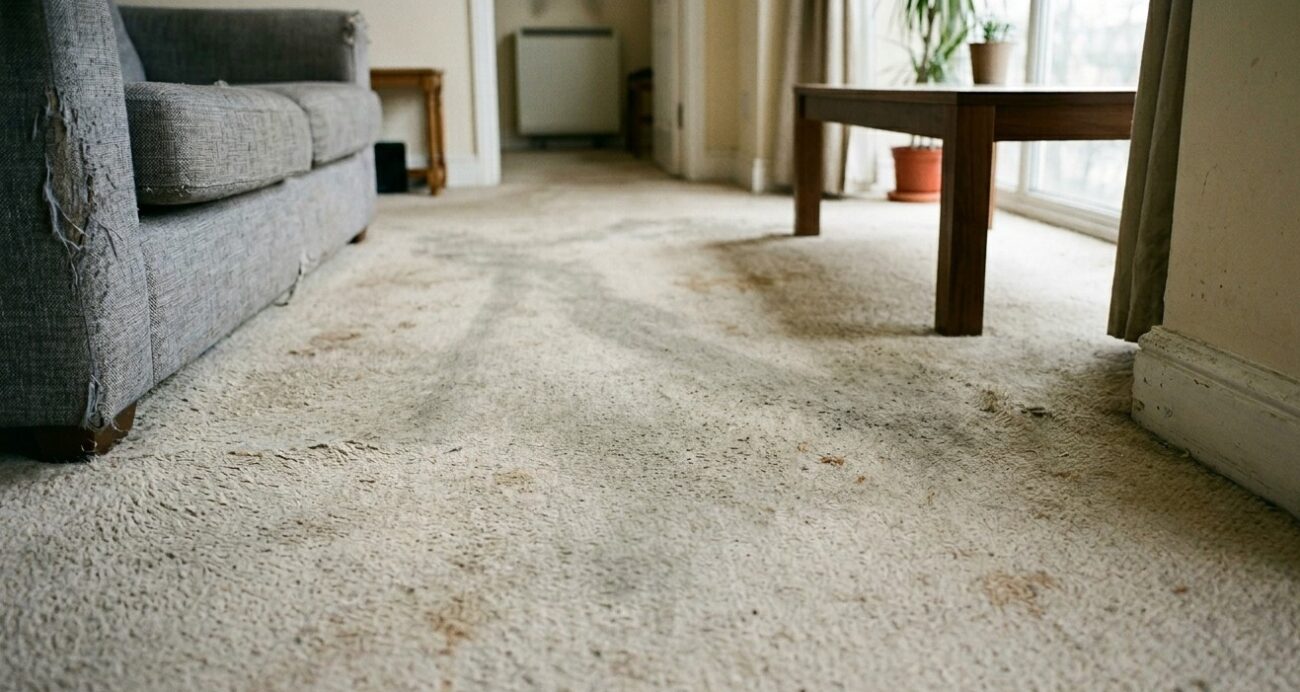
Few phrases in the English language generate as much tension between landlords and tenants as “fair wear and tear.” It sits at the centre of a remarkable proportion of deposit disputes, exchange of increasingly firm letters, and those particular conversations that start politely and deteriorate quickly. Everyone involved seems to have a confident view on what it means. Almost nobody agrees. And somewhere in the middle of it all, usually in a photograph taken on a phone camera in poor lighting, is a carpet.
Carpets are, by some distance, the most contested item in end-of-tenancy disputes. They are expensive to replace, they show evidence of occupation more visibly than almost anything else in a property, and the line between what constitutes ordinary use and what constitutes genuine damage is genuinely blurry in ways that make a firm ruling feel impossibly subjective. This article is an attempt to bring some clarity to that line – practically, specifically, and without taking sides.
What Does “Fair Wear and Tear” Actually Mean?
The term is not merely a vague social contract or a phrase invented by tenants to avoid accountability. It has genuine legal standing in English property law, and understanding its actual meaning is the necessary starting point for any sensible discussion.
Fair wear and tear refers to the reasonable and inevitable deterioration of a property and its contents through normal, everyday use over time. The key word is “inevitable.” It is the degradation that would occur regardless of how careful or conscientious the occupant was – simply as a result of the property being lived in by ordinary human beings going about their ordinary lives. A landlord is not entitled to return a property to mint condition at a tenant’s expense; they are entitled to recover it in the condition it would reasonably be expected to be in, given its age and the length of the tenancy.
This distinction matters enormously in practice, and it cuts in both directions. A tenant cannot hide genuine damage behind the wear and tear umbrella. But a landlord cannot charge for the natural ageing of materials that would have degraded anyway.
What Counts as Fair Wear and Tear on Carpets?
In practical terms, the following are generally considered to fall within the boundaries of fair wear and tear, and should not be chargeable to a tenant’s deposit:
Pile flattening in high-traffic areas – hallways, in front of sofas, along the route between the bedroom and bathroom – is the most straightforward example. Carpet pile compresses under foot traffic. This is what carpet pile does. After a tenancy of a year or more, some degree of compression in heavily used areas is entirely expected and wholly unremarkable.
Slight fading, particularly near windows where sunlight exposure is significant, is similarly normal. Carpet dyes respond to UV exposure over time. This is not tenant behaviour; it is physics.
Minor surface soiling that responds to professional cleaning – a general dulling of colour, light marks in traffic areas, the kind of low-level grubby haze that accumulates in any inhabited space – falls into wear and tear territory, particularly if the tenancy has been a long one. The appropriate remedy here is professional cleaning, the cost of which may or may not be chargeable depending on the checkout condition relative to the check-in inventory.
Small, isolated snags or minor fraying on carpets that were already several years old at the start of the tenancy also tend to fall on the wear and tear side of the line, particularly where the original condition was not pristine.
What Counts as Damage or Negligence?
Stains
This is where the conversation becomes more clear-cut. A stain – whether from red wine, pet urine, hair dye, grease, or any other substance that has been spilled and left untreated – is not wear and tear. It is the result of a specific incident, and in most cases, a specific failure to act. A tenant who spills something and reports it immediately, making reasonable efforts to address it, is in a considerably stronger position than one who allows a stain to set, dry, and establish itself over weeks or months. The stain itself is not automatically negligence; the failure to disclose or address it generally is.
Burns
There is essentially no scenario in which a burn mark on a carpet constitutes fair wear and tear. Burns – from cigarettes, candles, dropped irons, or any other heat source – are the result of a specific, avoidable incident. They are unambiguous damage, and they are chargeable.
Pet Damage
Pets introduce a specific category of carpet damage that sits clearly outside the wear and tear definition. Claw marks, urine contamination, chewing damage, and the particular destruction that certain breeds of dog apply to the edges of fitted carpets with a dedication that is almost admirable – these are all chargeable. The relevant question is usually not whether they are damage, but how much of the replacement or remediation cost can reasonably be attributed to them given the carpet’s age and pre-tenancy condition.
Excessive Soiling
There is a meaningful difference between a carpet that requires professional cleaning at the end of a tenancy – which is normal and may or may not be a tenant obligation depending on the tenancy agreement and initial conditions – and a carpet that has been allowed to reach a state of significant soiling through persistent neglect. Ground-in dirt, heavily soiled pile that has not been vacuumed regularly, and staining from accumulated spills that were never reported or addressed all sit in negligence territory rather than wear and tear.
The Age of the Carpet Changes the Calculation Significantly
This is the aspect of carpet disputes that landlords most frequently underestimate, and it is the one that the deposit adjudication services apply most consistently. A landlord cannot charge a tenant the full cost of replacing a carpet that was already eight years old at the start of the tenancy. That would constitute betterment – leaving the landlord in a materially better position than they were before the tenancy began – which the legal framework around deposits explicitly prevents.
Carpets in residential properties are generally considered to have an expected lifespan of somewhere between eight and fifteen years, depending on quality and use. At the end of that lifespan, a carpet has negligible remaining value regardless of how it was treated. A five-year-old carpet that has been damaged might reasonably attract a charge representing half the replacement cost. A twelve-year-old carpet in the same condition, considerably less so.
Age and condition at the start of the tenancy are therefore not background detail – they are central to any fair calculation of liability.
Why Condition Reports and Inventories Are the Whole Argument
If there is a single practical lesson in all of this, it is that the check-in inventory determines everything. An undisputed, photographically documented record of the carpet’s condition at the start of the tenancy is the only reliable basis for any claim at the end of it. Without it, both parties are simply asserting their recollection of what things looked like, which is – as anyone who has sat through a deposit arbitration will confirm – an extraordinarily inefficient way to resolve anything.
For landlords: a detailed, photographically evidenced inventory signed by the tenant at the start of every tenancy is not optional paperwork. It is the foundation of any legitimate deposit claim.
For tenants: the check-in inventory is equally valuable protection. Read it carefully, photograph anything it does not capture, and submit written notes of any discrepancies within the window provided. A stain present at check-in that is not recorded in the inventory is a stain you may find yourself being charged for at check-out.
Both parties benefit from the same document existing. The disputes that reach adjudication are almost always the ones where it does not.
What Professional Cleaning Can and Cannot Resolve
Professional carpet cleaning is frequently cited in tenancy agreements and checkout reports, and it is worth being specific about what it can realistically achieve – because it is neither a miracle solution nor an irrelevance.
Professional hot water extraction can remove significant soiling, neutralise odours including pet urine to a meaningful degree, and restore the appearance of a carpet that has been allowed to dull through infrequent maintenance. It can address many stains if they are treated promptly enough. In the context of deposit disputes, a professional clean can often resolve what might otherwise be a damage claim, simply by demonstrating that the underlying carpet – once properly cleaned – is in acceptable condition.
What it cannot do is reverse physical damage to fibres. Burns, tears, claw marks, and bleach damage alter the structure of the carpet permanently. No amount of cleaning addresses a scorch mark or a frayed edge. These require repair or replacement, and the cost of that work – adjusted appropriately for the carpet’s age – is where genuine negligence claims properly sit.
A Note on Reasonableness – From Both Directions
The wear and tear framework ultimately asks a simple question: would a reasonable person, looking at this carpet, consider this deterioration to be the natural result of normal occupation, or the result of something that should not have happened?
It is a question that rewards honesty from both sides. Tenants who have genuinely caused damage are not well served by hiding behind wear and tear arguments that will not survive scrutiny at adjudication. Landlords seeking to recover the full cost of a decade-old carpet because a tenancy has given them the opportunity to do so are equally unlikely to find the process going their way.
The carpet, in the end, is just evidence. What it is evidence of depends entirely on what actually happened – and on whether anyone thought to document it properly at the beginning.
